Auntie Ann Knits

Monday, February 25, 2008

Crazy Conservative Socks

As far as I can tell from Ravelry and the internet, the only other pair of these in existence is the sample for the pattern. Maybe there’s a good reason for that!

These are actually a lot of fun to knit (once I figured out the pattern instructions, which IMO could be clearer and more detailed), but I’m not sure yet how the finished sock will be. The pattern is by Gerdine Crawford-Strong, and can be downloaded free here.

BTW – the name I have given these socks is not a political commentary – the published pattern name is “Conservative Socks”, but mine are pink, purple and bright blue.

Ms. Crawford-Strong originated the “Strong Heel”, not named for its strength but for her. I don’t know all of the details of it, but it is supposed to make more attractive socks with self-striping yarn, with less interruption of the stripe pattern for the heel. There are a number of examples in blogland and on Ravelry. It reminds me a bit of Cat Bordhi’s “Cedar” construction, although again I don’t know the details of that.

cast-on
Picture 1: Cast-on, ribbing, and most of Section 1 triangle. It will be decreased down to a point, then the next section begins in the “V”. Section 1 is Dream in Color Smooshy, last seen in the “Flow Motion” socks.

Section 2
Picture 2: Section 2, mostly done. It starts with a triangle at the bottom, then parallelograms up each side of the Section 1 triangle (nearly done with second parallelogram), and then there will be a triangle on the top tying together the two parallelograms. Section 2 is the J.L. Yarnworks yarn, which is much, much prettier in person, but the scanner doesn’t seem to like it as much as I do, which is lots. It last starred in my “Purple Monkey” socks.

Heel turn done
Picture 3: Section 3 done, heel turn done. Section three includes all of the increases, sort of like the gusset of a traditional sock pattern. The heel turn is done over all of the heel stitches (blue triangle at the back of the heel) plus all of the increased “gusset” stitches (that is, over enough stitches to be the equivalent of the sock circumference). The pink is the Smooshy, of course, and the blue is Trekking yarn, previously seen in my “Falling Water” socks.

The pattern picture that downloaded looked as though Section 1 and Section 3 should be the same color, although that's not how the directions read. I decided to make them the same color. I ordered the back issue this was originally published in (hoping for clearer instructions, and there were some other interesting patterns in it), and the magazine picture clearly shows that indeed Section 3 was knitted in a different color than Section 1. Well, I still like my choice. Also -- the pattern is actually not even in the magazine -- there is some background explanation and a template for designing your own crazy socks, but you have to go to the website for the actual pattern. Crazy, no?

Anyway, this is a fun way to use up some yarn leftovers now that I've figured out the techniques for this sock. One of the reasons I started looking for sock patterns for bits and bobs of leftover sock yarn is that I had a lot of the Smooshy left over after the Flow Motion socks -- nearly half the skein -- and probably 1/3 of a skein of J.L. Yarnworks yarn left after the Monkeys -- and I could not let them just sit around. I just had to turn both of those beautiful yarns into more socks.

I'm weighing all the leftover yarns used in these socks both before and after knitting so that I can have a good idea how much I used of what, and which other leftover sock yarns might be combined into future Crazy Conservative socks.

If I'm crazy enough.

In other news, DD and I took a trip to the Gold Country in the foothills of California over President's Day weekend. We toured a working gold mine and two caves, one of which we took a 165-foot rappel down into. Big fun! Both she and I are experienced rappelers, but even the inexperienced rappelers had a great time and it is set up to be pretty much idiot-proof, as it should be. We also continued on for the crawling part of the tour, and once back above ground we did the zip line. I got back in touch with my outdoorsy, adventurous side, which has been somewhat dormant of late. If you're ever in that part of the world, I recommend this. Check out their website.

Alas, on our one day of skiing I fell clumsily and twisted my left knee pretty badly. I'm seeing the orthopodic guy Thursday. Hopefully a little PT and maybe a brace will be all that is in store for me. I tore my right ACL skiing about 6 years ago and have managed to avoid surgery for that so far, and hopefully won't need it for this tear/sprain/whatever.

The knee slowed me down only a little bit at Stitches West, but that's a story for another day.

Monday, April 07, 2008

Sock Lobster Love!

Just the two of us

The Crazy Conservative Socks are done. In fact, they have been finished for some time, but I have fallen out of the habit of blogging regularly.

No apology from me, though, because I have taken the pledge. The Blogging Without Obligation pledge. Personally, I think you should thank me for not blogging daily, because you would all be bored senseless, but whatever.

To the knitting!

sock yarn leftovers

To those of you who have been knitting socks for even a short time, this should be a pretty familiar sight. No doubt those of you who don't knit socks have seen similar sights, but in this case, this is entirely fingering-weight yarn left over from socks I have knit. Which means I have tiny balls of yarn in other weights also sitting around somewhere, just not in this picture. Some of this yarn was just too nice to let sit around this way. It deserved a better fate. (Some didn't, and it is still sitting around.)

More importantly, I had sufficient quantities of some of it to actually justify doing something with it. I picked just these:

yarn before

Not only are there more than just scraps here, but I love most of these yarns.

The pink is leftover Dream in Color Smooshy, which I won in a contest and used for my Flow Motion socks.

The purple is hand-dyed by J.L. Yarnworks, and I love it! I used it in my purple monkeys, which I loved so much and yet gave away. This was traumatic, and I asked Ms. Yarnworks to dye me some more purple sock yarn, which she very obligingly did. I have been meaning to post a picture of that new yarn, but the light was so bad for a while there, and I haven't taken a picture of it yet. I love the new yarn too, and I might have to make more Monkeys to commemorate the others.

The blue yarn on the left is from my Waving Lace socks, and the blue yarn on the right is from my Stanfield 196 socks. (BTW -- I now own Leslie Stanfield's excellent stitch pattern book, and it is beyond me why she is referred to in so many places as "Stansfield", with two letter S's, when her name has only one S. It could be because her book is out of print, but that's not much of an excuse, really. But I digress.)

I ended up not using the Waving Lace yarn at all, so I still have that. The only commercial yarn in the lot is a solid, and had to stand in for some of the Purple Monkey yarn. I wish I had had more of the Purple Monkey sock yarn left, but alas I didn't.

side by sidesole to sole

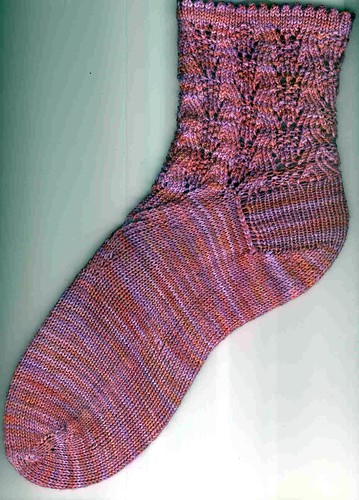
You can see here that the purple on the legs of the socks doesn't match. Ah, well. Bonus -- you can see that the Purple Monkeys sock yarn is very gorgeous. The scanner can't get its color right at all.

They look too big in the photos, don't they? But now, after a trip through the wash, they fit ju-u-u-ust right.

flexed

They are very Harlequin-esque. One might even say, ugly. But a pair is somehow so ugly they're cute.

These socks do fit well. The areas of the picked-up stitches between areas of color feel a bit odd when I first put the socks on, but after that they are not noticeable.

For those of you who might be interested, here are the yarn amounts used (I tried to make a pretty table, but I don't know how to get blogger to display it correctly):

Pink Smooshy: starting weight 1.9 oz.; Sock One used 0.6 oz.; Sock Two used 0.6 oz.; total used, 1.2 oz.

Purple Monkey: starting weight 1.0 oz.; Sock One used 0.3 oz.; Sock Two used 0.6 oz.; total used, 0.9 oz.

Solid purple yarn: starting weight 1.0 oz.; Sock One used 0.2 oz.; total used, 0.2 oz.

Stanfield 196: starting weight 1.1 oz.; Sock One used 0.2 oz.; Sock Two used 0.1 oz.; total used, 0.3 oz.

Total for each sock: 1.3 ounces.

These amounts were all weighed on our handy-dandy electronic postal scale. The socks are women's size 8, knit on a KnitPicks 2.5mm 32" circ., magic-loop style, as always.

yarn remnants

And here are the leftovers (of the leftovers). The blue yarn there (from the Waving Lace socks) wasn't used, but the other blue yarn was pretty much used up.

Modifications: the original pattern is a men's, I re-sized for my feet. The on-line picture is too dark and seems to show the colors arranged as I have them, but I now realize that the pattern is written with the colors arranged differently.

Would I make these again? Actually, I might. The design is interesting to knit, although I have some quarrels with the way the pattern is written -- it could be a lot clearer. But now I know how it goes, so that's no longer a problem. It's a pretty good way to use up leftovers of solid or semi-solid yarns that go together, and turn scraps into socks -- what's not to like about that? There are a lot of ends to weave in, but that wouldn't be enough to stop me. It can also be easily adjusted for different sizes. Now that I know more precisely how much yarn of the various colors I would need, I just might be able to use this again to turn scraps into socks.

Tuesday, January 08, 2008

Single-Stranded Flow Motion Sock

I have wanted to make Cat Bordhi's Flow Motion Sock since I first saw it in Vogue Knitting (Fall '06, if I recall right). It's also in Vogue Knitting's "Ultimate Sock Book".

But I didn't want to make it holding two strands of yarn held together, as the pattern calls for. I didn't really care to have a lacy sock in a heavy weight.

So recently I set about figuring out how to knit the same sock with a single strand of yarn. I used the Dream in Color Smooshy that I won as a prize a while back. Yum.

After a good deal of knitting, figuring and head-scratching, this is what resulted:

Flow Motion Sock

Sorry for the crummy pic, it's raining, raining, raining, and I have yet to build a light box or anything so fancy. The house is still very much in a construction mode and there is no room. DD, DH and I are all sleeping in the living room, and have been for several months. I can't decide which it reminds me of more, The Waltons or Little House on the Prairie. At least we still have our regular beds, and a working kitchen.

BTW, there is an error in the leg chart. Row 5, stitch 10, should be a YO. It's correct in the written instructions, and yet I first turned to knitblogs to solve my puzzlement over the chart error. Instead of just reading the darn instructions. Didn't even occur to me at first.

Naturally this pic, taken at my desk, doesn't do justice to the yarn. I love, love, love this yarn. It seems to have color changes / variations that would never pool or flash. Just lovely variation.

And here's a pic with flash, showing the stitch pattern a bit.

Stitch pattern

At first I didn't like the way the fabric was coming out -- all those twisted stitches. But it grew on me. I've cast on for the second sock.

Mods: Single stranded, knit on 2.25 mm circ Magic Loop style through the first repeat of the leg chart, then on 2.5 mm circ. Plain picot edge instead of seed stitch. 56 stitches around the foot, 64 stitches around the leg, with necessary fudging of heel turn and flap. I began the increases as indicated in the "Upstream" master pattern in New Pathways for Sock Knitters (this turned out a tiny bit too short for this particular pattern, which I have decided I can live with) and increased 3 times (6 stitches, 9 rows) before beginning the instep chart.

Then after the heel was done I had to match up the leg chart with the instep chart. This would ordinarily be clear if you were knitting the sock as written, but of course since I was throwing in 4 instead of 3 repeats of the leg chart, I had to work it out for myself.

I like this sock, but I don't think another pair is in my future. Knitting all of those twisted stitches in the charts is too troublesome. I had to really concentrate on loosening up my knitting, which no doubt would be a good thing in general.

I did very few holiday knits after the craziness I put myself through last year, and got through the holidays relatively sanely, for me. It helped that for me, my Mom and my brothers, we decided not to exchange gifts, but to spend a morning helping out at a center for the needy elderly. Before you think too highly of me for this, remember that I traded off a couple of hours of charity work for hours and hours of shopping and wrapping and returns. I think it was a heck of a deal, and we all had a nice time.

And we got very lovely knitted gifts from my buddy Liz --

Tiny Sweaters

Tiny sweater ornaments for the three of us with our first initials! They were perfect for the tiny tree we had this year, and will be great for years to come! Thanks, Liz!

Wednesday, February 13, 2008

How to Knit a Single-strand Flow Motion Sock

Blocked Flow Motion sock

At last, I have a decent portrait with a blocker and everything.

Maia suggested I should write up my mods for the single-stranded Flow Motion socks, and I am incredibly flattered by this. Maia is a fiber goddess, being spinner / dyer / knitter / designer and possibly weaver (have I missed anything, Maia?) all in one. Me, I just knit.

Since flattery of this type will clearly motivate me, I will now explain my mods. If you do not happen to be interested in knitting a single-strand Flow Motion Sock, you might want to just look at the pic and skip the numbers-blah-adding-blah-charts-blah-blah-blah below. I won't be offended.

First of all, the original pattern by Cat Bordhi (to be found in Vogue Knitting's Ultimate Sock Book as well as in Vogue Knitting, Fall '06 I believe) is written to be knit with two strands of yarn (Trekking sock yarn is the recommended yarn) held together and knit on size 6 (4mm) needles. Clearly this will result in a thicker sock than if knit with a single strand of yarn in the usual way.

I wanted to knit these socks, but with a single strand. What to do? I was somewhat at a loss until New Pathways for Sock Knitters: Book One came out. The Flow Motion sock is based on the "Upstream" sock architecture in that book.

I used the Upstream Master Pattern and cast on to knit from the toe up, per the instructions (using a pretty ordinary toe instead of one of Cat's), using a 2.25 mm KnitPicks circular needle. My yarn, by the way, is Dream in Color Smooshy sock yarn. The gauge I was getting was 8 SPI. For my 9" foot length and 8" foot circumference, the formula in the book called for me to increase to 56 stitches around and then to knit to 4.33 inches before doing the instep increases.

Now, the chart for the instep increases is 26 rows, increasing from 2 to 33 stitches, meaning it has 31 increases. This was not going to give me enough stitches to match Cat's Master Numbers for me for this sock, and I knew that at the smaller gauge there would not be enough rows to give me the right length. I needed to knit more rows, and to increase from 56 stitches to -- well, there was a little confusion at this point.

The chart would have me increase to 96 stitches, but at the same time said that "the arch expansion total is nearly always equal to the midfoot total plus half the midfoot total", which would give me 84. I went with 93, somewhere in the middle but much closer to the chart number. An even larger number might have worked a bit better -- the socks are a little hard to get on, but they fit alright once on.

So, additional rows and increases needed to be worked to get the midfoot stitch total (56) plus the increases from the chart (31) to the desired stitch count (93). Six additional increased stitches, in fact, in my example.

I can't really explain how I decided how many additional rows to do. Guesswork would probably be the most honest answer. I worked 6 extra rounds (a few more would have been better), increasing two stitches every other row, before beginning the chart. These extra increases began on either side of the center instep stitches, and moved outwards as I went. Place markers on either side of the 2 center instep stitches and increase in the stitch before the first marker and the stitch after the second marker, every other round. I used Cat's LLinc and LRinc increases. YO's would be interesting, too.

ETA: I realize now that's not how I actually did it. It would work, with increases spreading out of the two center stitches. What I did, though, to echo the "V" of the instep chart, was make a right-leaning increase in the first stitch after the first marker, and a left-leaning increase in the stitch before the second marker. That way, the markers keep moving outward as you make the increases.

After the last plain round I began the instep chart. Move the two markers back to either side of the center two instep stitches, and then begin.

Once my instep chart was done, I worked a plain heel using Cat's instructions, decreasing per the toe-up heel decreases until I had 64 stitches. The leg chart is 16 stitches across and the original pattern calls for 3 repeats around the leg (48 stitches around the leg). Four repeats and 64 stitches around were appropriate for this size sock in this gauge.

I have two important tips for you here --

The first is that there is an error in the leg chart (the written instructions for the leg pattern are correct as written). In row 5, stitch 10 is shown in the chart as a plain knit stitch, but it should be a YO.

The second is -- where do you start the leg chart? The instructions only make sense if you are knitting the original pattern.

After careful reading and scratching my head and thinking about where the beginning of the chart would have fallen if I were knitting the original pattern, I came up with the answer.

You begin the leg chart on top of the 5th stitch of the last row of the instep chart.

That's a pretty bland statement there, isn't it? But at the time it seemed like a major breakthrough.

Knit (plain knit stitches in the plain ones, KBL if the stitch below is KBL) until you have knit the 4th stitch of the last row of the instep chart, then place a marker and begin the first repeat of the leg chart.

I changed to a 2.5 mm needle when I began the leg, since the instep and heel were a little tight -- I sure didn't want the lower leg to be so tight I wouldn't be able to get the socks on.

And now you're home free, nearly. Work the leg chart four times around, four times, do the top edging of your choice (I chose a plain picot edge instead of the seed stitch picot edge in the pattern), et voila.

And in the timeless tradition of completely pointless instructions everywhere, let me add: Make second sock.

Other pics of my socks in my previous posts are here.

Questions? Bouquets? Rotten tomatoes? Let me know.

Monday, October 15, 2007

Meanwhile, back at the ranch . . .

When we left our story, I was expecting some prize yarn that I won in connection with the Red Scarf Project. Yay!

The yarn was generously donated by Ronni, who spoiled me a little in addition to sending me the yarn. This is why I don't do swaps, people -- I just can't keep up!

Me, I'd have just stuck the yarn in the box and figured I was lucky just to make it to the post office with it. Ronni wrapped it up in very pretty tissue paper, with a yarn bow, of course, and even a card:

Prize box

Prize wrapping

And what's that tied in the bow?

It's a beautiful stitch marker that she made especially to go with the yarn:

Prize stitch marker 2

And the yarn itself is so lovely:

Prize yarn

It's Dream in Color Smooshy, colorway "Wisterious". I'm looking forward to knitting with this, let me tell you.

Thanks again, Norma and Ronni!